
Month: August 2022

  • School leaders! Want to customize literacy PD for your school this year? We can help.

    School leaders! Want to customize literacy PD for your school this year? We can help.

    If you’re a school leader, an instructional coach, or a teacher longing for science-aligned but practical professional development, we have something that can help. With the current push for more science-aligned literacy practices and with the start of a new school year, we wanted to let you know about our custom class offerings. 

    You’ve likely heard about our online class, based on Shifting the Balance: 6 Ways to Bring the Science of Reading into the Balanced Literacy Classroom.

    But, what you may not know is that we offer the opportunity for schools and districts to support a custom cohort of the class, specially designed for their school, district, situation, and schedule.

    Custom courses include:

    • Anytime access to all of the content in our regular online class, including video, audio, and printable resources.

    • Extended access to the course content for up to 6 months (vs. 9 weeks).

    • A content rollout schedule customized to your scheduling needs so that you can use the content on PD days, early dismissal days, PLC meetings, etc. 

    • A shift-by-shift guide book to deepen learning, guide the collaborative conversation, and help teams of staff members identify actionable next steps. 

    If you’d like to learn more about leveraging Shifting the Balance: The Online Course as an extended professional learning experience for your school or district you can read more in this informational flyer. If you have more questions or are ready to customize a course for your setting, you can reach out to Maggie at CustomCourses@TheSixShifts.com 


    ❤️Jan and Kari

    P.S. We are creating a separate mailing list with the content just for school leaders. 

    If you are a school or district leader, an instructional coach, or anyone who helps your school make decisions about professional development, you can join our Literacy Leadership List here. 


  • 4 Simple Steps for Using Elkonin Boxes to Help Children Lock Words in Memory

    4 Simple Steps for Using Elkonin Boxes to Help Children Lock Words in Memory

    Orthographic mapping (Ehri, 2014) is essentially alignment work. It is the brain making sense of, or proving, how the sounds in a spoken word (phonemes) match up with the series of sound-spellings in the same word (graphemes).  

    So, if orthographic mapping is truly an “in-the-brain-process,” what can we do in the classroom to set the reading brains of young children up for success with this internal process? 

    Well, one of the best tools we know of–our go-to for scaffolding orthographic mapping–is sound boxes, or Elkonin boxes (Elkonin, 1973). The beauty of sound boxes is that they provide a concrete tool for communicating and reinforcing what can otherwise be very abstract work. 

    In the numbered list below, we offer four simple but powerful steps for using Elkonin boxes to scaffold orthographic mapping from the OUTSIDE to increase the likelihood that it happens on the INSIDE! We demonstrate this series of steps using the word sheep.

    So, here’s how you can put sound-spellings in their place!

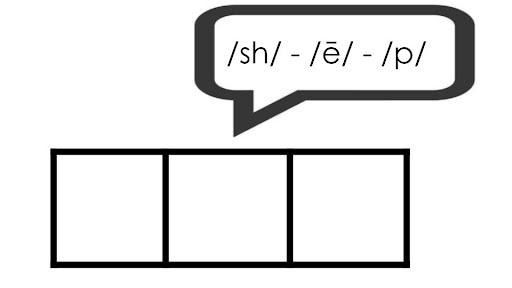
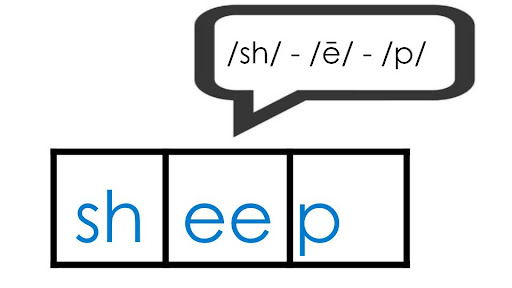
    1. Decide how many boxes are needed. To get started, simply provide or create a long, rectangular box and divide it into the number of sub-compartments that matches the number of individual sounds in the word. So the word sheep needs three sections for its three sounds, or phonemes (/sh/ /ē/ /p/).

    2. Put one grapheme in each box. Now you’re ready to use one box to hold the grapheme for each phoneme in the word. We sometimes describe Elkonin boxes to children as a house with multiple rooms; each room gets one sound. Of course, some sounds are represented by graphemes that have more than one letter, such as the /sh/ sound in sheep. When one sound is spelled with two (or more) letters, then all of the letters in the grapheme go into the same box or room. In the example below, you can see that sheep has two sounds that are spelled with graphemes that have more than one letter. In the first box, the S and the H are roommates representing the single sound /sh/. And in the middle box, the letters E and E are roommates, spelling the single sound /ē/

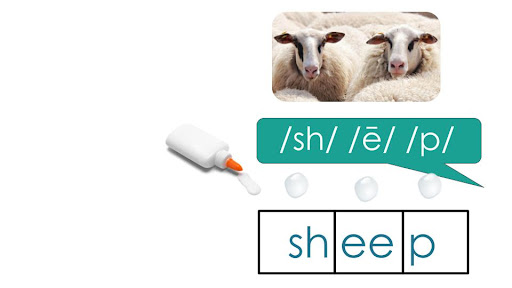
    3. Carefully analyze the alignment. Support students in blending the sounds and noticing the way the individual sounds match up with their individual spellings. This alignment work glues the sound-spellings–in their meaningful sequence–to the matching sequence of the individual sounds in the spoken word. And this is how words are stored in the reading brain, so this is the critical work that helps lock the word into memory.

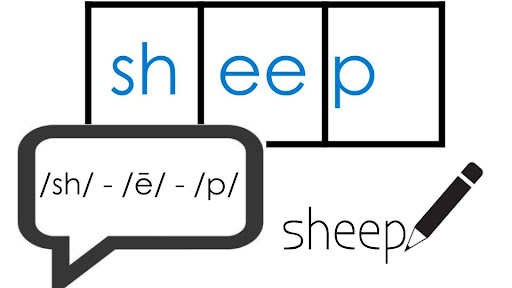
    4. Write the word outside the boxes. To seal the deal, have children pull the word back out of the boxes and write it for themselves. Writing it a few times – referring to the sound boxes and saying the sounds as they write the letters or letter combinations (graphemes). This careful attention to the sounds that go with each grapheme really supports getting the word stored in memory. You can have children write the word a couple of times while sound-saying and using the sound box as a support. And then have children write it again–still sound-saying–but from memory.

    Elknonin boxes are a versatile tool with countless applications in the literacy classroom. For instance, they can be used to: 

    • Enhance phonemic awareness instruction.

      • “Three sounds in sheep, so three sound boxes. Touch each of the boxes as you say the sounds in sheep.” , 

    • Scaffold word learning. 

      • “The word sheep has three sounds but five letters. Let’s think about (look at) how the sounds and spellings match up.”

    • Support students who are trying to work out the spelling of a word.

      • “You’re trying to spell sheep? How many sounds do you hear? Right, three. So let’s make three boxes. Now, touch each box as you say the sounds again. What spellings do you expect for the first, middle, and last sounds in sheep? Write them in the boxes.” 

    If you’re committed to scaffolding the in-the-brain process of orthographic mapping with outside-the-brain instructional routines, getting comfortable with Elkonin boxes is definitely worth the investment of time and energy.  They provide an affordable, visual, brain-friendly, effective, reliable, and accessible tool.  😊

    If you’re ready to dig deeper into the ways you can use Elkonin boxes to make word learning easier for children, you can check out Sight Word Success, our on-demand mini-course that teaches all about orthographic mapping, including more tools to support it!  


    References

    Linnea C. Ehri. 2014. Orthographic Mapping in the Acquisition of Sight Word Reading, 

    Spelling Memory, and Vocabulary Learning, Scientific Studies of Reading, 18:1, 5-21. https://registrar.ecu.edu/wp-content/pv-uploads/sites/257/2019/07/ehri.pdf

    Elkonin, C. (1973). Methods of teaching reading. In J. Downing (Ed.), Comparative reading: 

    Cross national studies of behavior and processing in reading and writing (pp. 


    551-579). New York: McMillan.


  • Sight Word learning in 1-4 exposures! That’s crazy talk! Or is it?

    Sight Word learning in 1-4 exposures! That’s crazy talk! Or is it?

    If we asked you to guess how many encounters with a new word a typical reader needs to be able to retrieve the word instantly and automatically, without guessing, decoding, or relying on other hacks . . . what number would you guess? 

    20? 30? 40? More? 

    Well, you might be surprised to learn it’s a lot less than that! 

    It’s not 10! 

    It’s not even 5! 

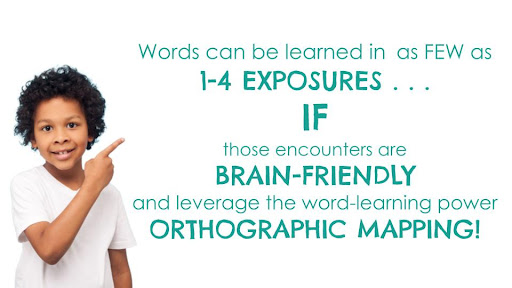
    Research shows it is between 1-4! (Kilpatrick, 2017) 

    But if you’re like most of us, right now you might be saying . . . 

    What?! Wait! 

    Not my kids! 

    Not in my experience! 

    We’ve been there, too! 

    Rainbow writing, 

    Mix-and-fix. 

    Playdough. 

    Cards on rings. 

    Computer games. 

    Worksheets.

    Highlighting high-frequency words in printable readers. 

    The list goes on and on. 

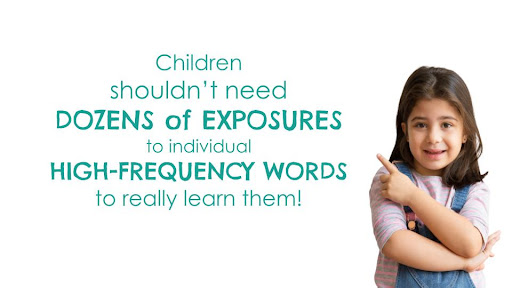
    Yet, the truth of the matter is that kids shouldn’t need dozens of exposure to individual high-frequency words to really learn them. The problem is, that lots of the methods we’ve used in the past have been driven by myths and misunderstandings about how children learn words. The vast majority of us were taught that kids have to spend lots of time working to memorize high-frequency words visually!  

    But the really great news for all of us (and especially for children) is that when you teach words in ways that tap into the secret ingredient of word learning–orthographic mapping–children learn them MUCH more quickly and efficiently. 


    When students engage in orthographic mapping–the process of aligning all the sounds and spellings of a word–words become “eligible” to get stored away for INSTANT, AUTOMATIC retrieval. Through orthographic mapping, these words become recognize-them-as-soon-as-they-see-them words, the kind of word learning that you want for all of your students.

    Orthographic mapping–

    Call it the secret ingredient to word learning.

    Call it the glue that makes words stick. 

    Call it OM. 

    Call it magic. 

    Whatever you call it, orthographic mapping, originally described by Linnea Erhi (2014),  MUST happen before words can be truly known! In fact, every word that YOU read automatically (which is almost every word you encounter as a proficient reader), was mapped before it got stored.

    Better yet, once words are learned through orthographic mapping, they don’t go away! Kids don’t forget them. They can read them instantly. They can write them fluently. They are forever part of their word knowledge stores. 

    Still, orthographic mapping is an in-the-brain process. We can’t do it “for” kids, but we utilize instructional techniques that connect phonology (the sounds in words) to orthography (the spellings of those sounds)  in ways that increase the speed and likelihood that orthographic mapping will happen. 

    And the really great news is that by using brain-friendly word mapping in our instruction with children, we can help them become efficient word mappers who are prepared to leverage orthographic mapping to learn words on their own!

    We know you want to help children learn more words more quickly (and forever), and you can do that by replacing memorization with mapping! If you want to learn more about the WHY and the HOW of more brain-friendly and science-aligned methods for high-frequency word instruction–especially orthographic mapping–we invite you to join us in our brand new on-demand, mini-course – Sight Word Success. 


    Linnea C. Ehri. 2014. Orthographic Mapping in the Acquisition of Sight Word Reading, Spelling 

    Memory, and Vocabulary Learning, Scientific Studies of Reading, 18:1, 5-21. https://registrar.ecu.edu/wp-content/pv-uploads/sites/257/2019/07/ehri.pdf

    Kilpatrick, David A. 2017. Equipped for Reading Success: A Comprehensive, Step-by-Step Program for

    Developing Phonemic Awareness and Fluent Word Recognition. Syracuse, NY: Casey and Krisch Publishers.


  • Looking for a bit of ✨magic✨in your sight word instruction? Start here!

    Looking for a bit of ✨magic✨in your sight word instruction? Start here!

    Explore the thinking behind effective high-frequency word instruction and how connecting sounds and spellings helps make words stick.

    The real magic, of course, comes from HOW you teach high-frequency words. 

    And spoiler alert – successful word instruction has everything to do with leveraging the power of orthographic mapping. We will tell you more about orthographic mapping in upcoming posts in this series. 

    But let’s face it.  There are lots of words in the world and lots of lists of high-frequency words floating around. So, before we can even teach the first lesson we have to decide…

    Which words are most important to zoom in on? After all, time is precious! 

    Well, our favorite research-backed list is what we’ve come to call 109 Power Words.

    We highlight this list in Shift 4 our book, Shifting the Balance (Stenhouse, 2021). You can grab a free download of the list here. 

    What’s so powerful (or magical) about these 109 words?  

    Three things really.


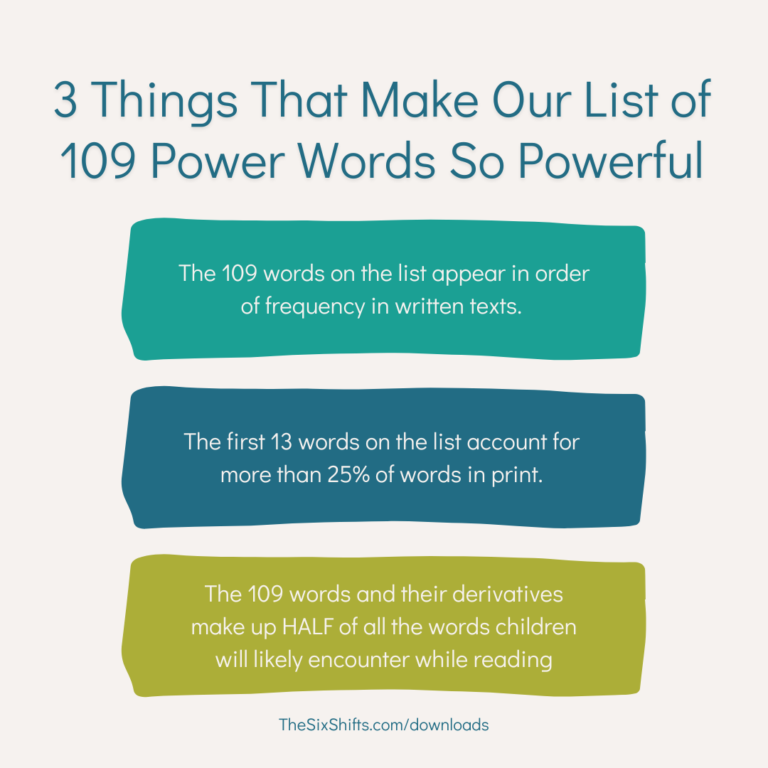
    1. The 109 words on the list appear in order of frequency in written texts.

      That means, for instance, that the first word on the list – the little word THE– is THE most common word in written English. Pick up any written text. It won’t be long before you encounter the word THE.

    1. The first 13 words on the list (the word THE and 12 more of its closest friends) 

      account for more than 25% of words in print. Yes, you read that right–13 words = 25% of words in print! Just think of the power that knowing these 13 small but mighty words can give beginning readers! We find this incredibly cool. On our list, we placed an asterisk next to each of these 13 words–sort of like giving them a gold star–to make it easy for you to spot them and prioritize them..

    1. As a collective group, these 109 words and their derivatives (i.e. look, looked, looking, looks) make up HALF of all the words children will likely encounter while reading (Adams 1990; Blevins 2017; Carroll, Davies, and Richman 1971). That’s 50% of the words children read! 

    But hold on! It gets even better. 

    Equipped with these 109 words plus basic phonics knowledge, your students should be able to read 90% of the single-syllable words they encounter in texts (Solity and Vousden 2009). 90%!

    And speaking of phonics instruction, another important thing to recognize about this list–or any list of high-frequency words–is that they don’t all have to be taught!  Many of the words on this list have completely regular spellings and therefore won’t need explicit instruction if you help children become both efficient decoders and strong word mappers (skilled with engaging the in-the-brain process of orthographic mapping). 

    This is information you can definitely take to the lesson planning bank to make learning to read easier for your students! 

     Want to learn more about brain-friendly ways to teach high-frequency words?

    In our Sight Word Success (SWS) Mini-Course, we teach you all you need to know to make high-frequency words (like these 109) really stick! We also teach a tried-and-true process called WHICH WORDS WHEN, designed to help you prioritize the words and their order for instruction.  

    If you’re ready to make learning high-frequency words easier for children, we invite you to join us!

    Adams, Marilyn J.  1990.  Beginning to read: Thinking and learning about print.  Cambridge, MA: MIT Press.

    Blevins, Wiley.  2017.  A Fresh Look at Phonics: Common Causes of Failure and 7 Ingredients for Success. Thousand Oaks, CA: Corwin.

    Burkins, Jan, and Kari Yates. 2021. Shifting the Balance: Bringing the Science of Reading into the Balanced Literacy Classroom. Portsmouth, NH: Stenhouse Publishers.

    Carroll, John B., Peter Davies, and Barry Richman.  1971.  Word Frequency Book.  Boston: Houghton Mifflin.

    Solity, Jonathan and Janet Vousden.  2009.  Real books vs Reading Schemes: A New perspective from Instructional Psychology. Educational Psychology 29(4): 469–511. doi:10.1080/01443410903103657


  • “But you KNOW that word!” Sound familiar?

    “But you KNOW that word!” Sound familiar?

    We’ve all been there! 

    We’ve all said some version of this phrase! 

    After chanting and practicing and highlighting and rainbow writing a word repeatedly, a student encounters the word in print (or goes to use it in their writing) and looks at it like it’s a martian with three heads! 

    And we find ourselves chiding, “You know that word. You just practiced it yesterday!!” 

    But, actually, they don’t. Otherwise, they would read it with ease. 

    It’s not that they’ve learned the word and forgotten it.

    The truth is, when we really know a word, we just don’t forget it. When children don’t recognize a word, it’s that they haven’t actually learned the word in an EFFECTIVE, BRAIN-FRIENDLY way–a way that makes the word stick in their memories. . . 


    And that’s usually because so many of us – ourselves included – have taken a “just-have-to-memorize- them” approach to teaching high-frequency words, especially when words have funky or irregular spellings.

    We say things like,  “You just have to know ‘em when you see ‘em” or “This word breaks the rules so you just have to memorize it.” Statements such as these have become our mantra, and they represent some of the most closely held beliefs about how we learn words..  

    And this assumption that word recognition is primarily a sight-driven activity, makes perfect sense, after all it sure feels like . . .

     . . . when we see a word like said, we simply recognize it visually in the same way we would recognize a chair, or a horse, or a bottle of mustard. But, although it’s true that the eyes are the doorway for written words to enter the circuitry of the brain, the brain doesn’t actually have the capacity to visually memorize the 30,000 – 70.000 (Kilpatrick, 2017)  words proficient readers know instantly and automatically. 


    While words do enter the brain through the eyes, they aren’t stored visually. David Kilpatrick likens this to bringing a new vacuum cleaner into your home. You bring it in through the door, but that’s not where you store it. It has to get put away in an accessible closet for easy retrieval.

    As it turns out really knowing words (getting them into the brain’s accessible word closet) in ways that enable lightning-fast and reflexive retrieval can only happen when the brain builds high-speed connections between the word’s phonology (sounds), orthography (spellings), and meaning. This process is known as orthographic mapping (Erhi, 2014).


    In upcoming posts in this series, we will tell you more about orthographic mapping and how the brain really learns to read and write words automatically. But, if you can’t wait, or if you want to go even deeper than a blog series, we invite you to be part of our new, on-demand mini-course, Sight Word Success (SWS). In this quick but power-packed course, you’ll learn the WHY and the HOW of more science-aligned and brain-friendly word instruction. 


    Say goodbye to, “But you know that word!”  And say hello to, “Yes! You know that word!”

    We’ve launched a new, on-demand mini-course that is all about orthographic mapping and how to teach high-frequency words in sticky ways.

    It’s called Sight Word Success, and we’d love to have you be a part of it!

    Linnea C. Ehri. 2014. Orthographic Mapping in the Acquisition of Sight Word Reading, Spelling 

    Memory, and Vocabulary Learning, Scientific Studies of Reading, 18:1, 5-21. https://registrar.ecu.edu/wp-content/pv-uploads/sites/257/2019/07/ehri.pdf

    Kilpatrick, David A. 2017. Equipped for Reading Success: A Comprehensive, Step-by-Step Program for 

    Developing Phonemic Awareness and Fluent Word Recognition. Syracuse, NY: Casey and Krisch Publishers.