
Four ways to help phonics programs support reading, spelling, meaning, and language
A Lot Has Changed in Phonics Instruction
Chances are you’ve been working hard to master evidence-based routines.
Your instruction may be more systematic, more explicit, and more carefully sequenced than it was even a few years ago.
You may have deepened your understanding of ideas such as the alphabetic principle and orthographic mapping.
Your school may even have invested significant time and energy in a new phonics curriculum.
These are all good things.
Yet even with a strong phonics program in place, there are still moments when your students need more.
A child decodes a word successfully today but cannot read or spell it tomorrow. Another can sound out the word but has no idea what it means. You may notice that spelling practice is thinner than you would like, or worry that language comprehension sometimes gets the short shrift when so much attention is focused on decoding.
These are real challenges. And no matter how strong your program is, it cannot anticipate which words your students already know, which meanings they may miss, or where they will need more time and practice.
That part is left to you, the teacher who is already short on time.
But what if some of the support your students need is already hiding inside the lessons you are teaching? What if, with just a little more attention to the words already there, you could get a bigger return on the time and energy you are investing in phonics instruction?
Well, you can. And the key is to recognize that four opportunities are tucked inside every word your students decode.
Beyond Decoding: Making the Most of Phonics Practice
When you think about phonics practice, you probably think first about decoding. Can the child look at the word, connect the spellings to sounds, blend those sounds, and arrive at the word?
That work matters enormously.
But every word in a phonics lesson offers more than one opportunity. Yes, you want children to read it. But there are also opportunities to help them make the word truly their own by learning to spell it, understand it, and use it.
Keeping all four ways of knowing a word in mind during phonics instruction can help you notice when a word is waving its arms, asking for a little more attention.
Take a simple word such as mint. A child may look at the print, connect the letters to sounds, blend the word, and say mint.
Success.
But then what?
Does the child picture a plant? A candy? Do they know that a mint can also be a place where coins are made?
Sometimes you move on. Sometimes one small word gives you a little more to work with.
A child may be able to read a word but not spell it. They may be able to read and spell it but not understand it. They may understand it when someone else uses it but never use it independently in conversation or writing.
Four Opportunities So Simple You Might Overlook Them
Read it. Spell it. Understand it. Use it.
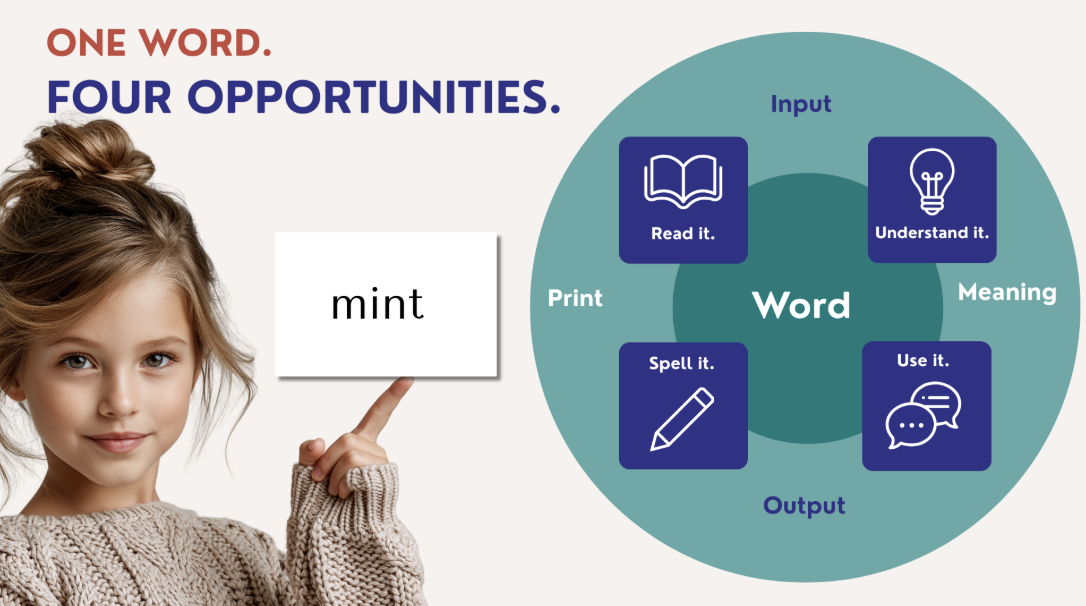
So let’s take a quick walk through the four opportunities and a few simple ways to weave them into the work you are already doing.
A warning, though: the ideas below are intentionally simple. Almost ridiculously simple.
That is the point.
You are not adding another lesson to your day. You are making the most of the moment by taking a few carefully chosen words just a little deeper.

Read It: We decode print to read words.
This opportunity helps children move from print to a recognizable spoken word.
Can the child attend to all parts of the word, connect the spellings to sounds, and blend those sounds into a recognizable word?
This is the heart of decoding practice.
But even here, meaning plays an important role. As a child decodes a word, the brain is naturally listening for something it recognizes. Familiar spoken words help confirm or adjust the pronunciation built from print. When the word is not already part of the child’s oral vocabulary, the brain has nothing familiar to recognize and match it to.
Making the Most of the Moment
- • Teach children to blend continuously, without gaps between sounds.
- • Ask, “Does that sound like a word you know?”
- • Have children reread the word after confirming its meaning.
Spell It: We stretch sounds to spell words.
This opportunity helps children move from a spoken word back to print.
Can the child segment the sounds in a whole word and represent each one in writing?
Reading and spelling approach the same word from opposite directions: decoding and encoding. But decoding often steals the show during phonics instruction. When you give children a chance to spell a word, they strengthen the sound-spelling connections they are learning.
Making the Most of the Moment
- • Have children stretch the sounds and write the word.
- • Teach children to check by moving a finger under each spelling as they say its sound.
- • Reveal the spelling so they can confirm and revise if needed.
- • Challenge students to change only one phoneme to write a new word.
Understand It: We connect words to meanings and ideas.
This opportunity helps children connect words with meaning.
Does the child know what the word means?
A word may be simple from a decoding standpoint and still be unfamiliar from a language standpoint. A kindergarten student may easily decode words such as vat, slat, and tiff without actually understanding them.
If we want the words children decode today to be stored for quick retrieval tomorrow, meaning matters. Orthographic mapping depends on connecting three things: sounds, spellings, and meaning.
Even simple phonics patterns can produce words with multiple meanings. Remember our example, mint. Sometimes the opportunity is not to introduce a brand-new word, but to add another meaning to one children already know.
Making the Most of the Moment
- • Offer a brief, child-friendly definition.
- • Show a picture or real object.
- • Use the word in context.
- • Watch for opportunities to explore multiple meanings.
Use It: We use words to express ideas.
This opportunity helps children make the word their own in writing or conversation.
Can children retrieve the word and use it in conversation or writing?
Recognizing a word when someone else uses it is not the same as making it your own. Children need opportunities to try words out in language. With simple partner routines, students can take words for a test drive in conversation or writing.
Making the Most of the Moment
- • Model word use by weaving the word into your instruction beyond the lesson.
- • Provide an image and have partners exchange sentences using the word.
- • Have students write one sentence using the word.
- • Encourage, notice, and celebrate student use of new words beyond the lesson.
Read it. Spell it. Understand it. Use it.
As you look at your current phonics instruction through this four-part lens, ask yourself:
- • Which of these are already strong and consistent in your instruction?
- • Which might be getting a little less attention than you would like?
- • Which present the most important opportunities for your students?
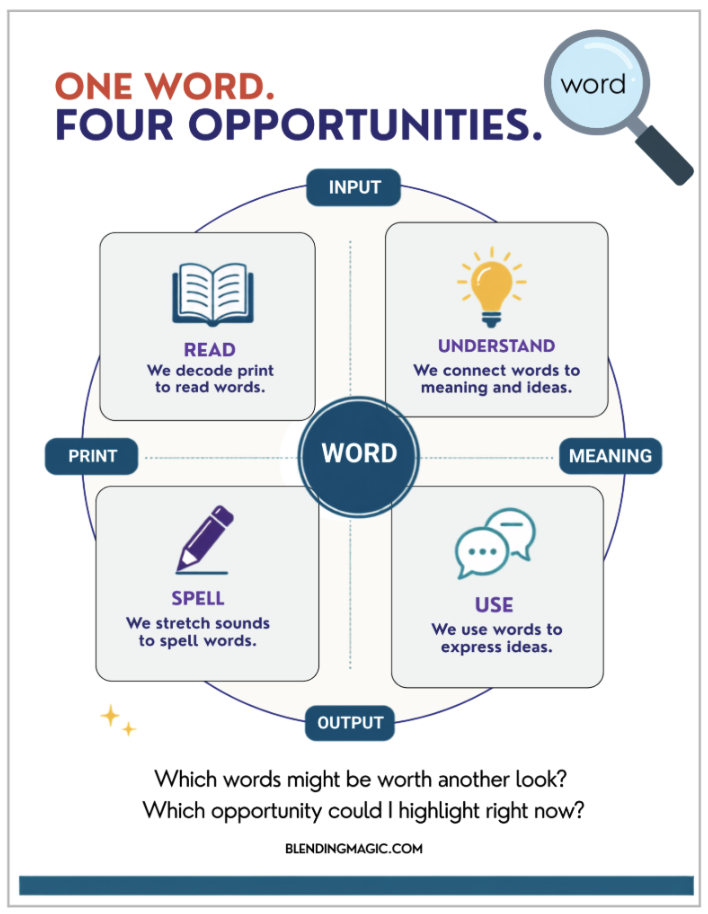
Want a quick way to keep all four opportunities in view?
Download One Word, Four Opportunities, a one-page printable you can keep beside your phonics materials.
Not Every Word Needs More Time
To be clear, the goal is not to address all four opportunities with every word in a phonics lesson. That would take more time than you can afford, and it would not always be necessary.
Some words are already familiar. Your students decode them accurately, understand them immediately, and are ready to keep moving.
The trick is noticing which words deserve a little more attention. Maybe the word is unfamiliar. Maybe it has multiple meanings. Maybe your lesson provides plenty of decoding practice but fewer opportunities for spelling, meaning, or use.
Even then, the extra move may be tiny: a picture, a quick definition, a gesture, a brief partner exchange, a sentence, or a spelling check.
You are not turning every word into a fifteen-minute vocabulary lesson. You are simply noticing when one small move could help children know a word more fully.
That is the part no program can completely plan for.
The program does not know your students.
You do.
Making Phonics Practice More Complete
Once you begin looking through this four-part lens, it becomes easier to notice where your phonics practice is already strong and where a small addition might help.
You do not need perfect balance in every lesson. But across time, you do want children to read, spell, understand, and use words in ways that help make those words truly their own.
The good news is that these opportunities can fit naturally into the lessons you are already teaching. You are not adding another block of instruction. You are making more of the time, words, and materials already in front of you.
A Flexible Companion for the Phonics Program You Already Use
This is exactly why we created Blending Magic.
Blending Magic is not another phonics curriculum. It’s a flexible collection of teacher-led interactive lessons and independent practice tools designed to connect decoding and spelling with meaning, language, and use.
During each teacher-led lesson, children work through a blending line one word at a time. Then you advance the slide, and an image magically appears. You are the Oz behind the curtain, controlling the pace and deciding when to pause, confirm meaning, or explore another meaning.
The same words return through spelling and sentence practice, helping children know them from several directions.
Use Blending Magic for whole-group practice, small groups, or targeted support with a particular spelling pattern.
See Blending Magic in action:
The goal is simple: help you get more from the phonics instruction already in place.
Because sounding it out matters.
But it is only one way of knowing a word.