

If you're looking for reading strategies for struggling readers in the upper elementary grades, you've probably already discovered there's no shortage of advice.
Some say focus on phonics. Others say focus on comprehension. Some suggest more independent reading time. Others recommend more sight-word practice, apps, or digital programs designed to feel like games.
Catching Up vs. Keeping Up: Bridging Literacy Gaps in Grades 3-5+
Join literacy consultant Kari Yates to explore the fundamental dilemma upper-elementary educators face every day: navigating the constant tug-of-war between helping struggling readers catch up on missing foundational mechanics and keeping up with grade-level curriculum core competencies. Learn small-group shifts designed to build unified paths forward.
Meanwhile, you know that with every passing day, the gaps and challenges for these students seem to compound.
The problem is that many older struggling readers need support in several areas at once.
A fourth grader may still be working through foundational decoding gaps. At the same time, that student is expected to read increasingly complex texts, learn new content in science and social studies, write about what they've learned, and navigate increasingly sophisticated academic vocabulary every year.
No wonder teaching older struggling readers can feel so challenging.
Ultimately, the goal isn't simply to fill gaps in unfinished learning from earlier grades. It's to fill those gaps while continuing to move students forward with this year's content and expectations.
The most effective reading intervention strategies for struggling readers do both. They provide targeted support where students need it most. But they do so while also keeping students connected to grade-level reading, writing, vocabulary, and content learning. Sound like a tall order?
It may be. But keep reading, because below you'll find seven practical principles that can be game-changers for older struggling readers without making instruction feel more complicated than it already is.

1. Keep Grade-Level Text and Content Learning at the Center
One of the biggest mistakes we can make is assuming readers who’ve fallen behind their peers need less exposure to complex ideas.
In reality, they often need more.
Science, social studies, literature, and other content areas provide opportunities to build knowledge, encounter academic vocabulary, and engage in meaningful discussions. When intervention replaces those experiences, students can fall even further behind.
Older students with literacy gaps rarely benefit from being handed "little kid" work simply because their skills are below grade level. Their gaps may look younger, but they aren't younger. They still deserve interesting topics, rich discussions, and opportunities to learn alongside their peers.
This doesn't mean handing students a challenging chapter from a grade-level textbook and hoping for the best. It means thoughtfully selecting and scaffolding grade-level texts so students can successfully engage with important ideas. Sometimes that might be an excerpt from a longer text. Other times it might be a poem, a short informational passage, a readers’ theater script, or a carefully chosen article connected to a science or social studies topic.
For example, if fifth graders are learning about energy in ecosystems in science, look for short texts, poems, fluency passages, or articles that help build the vocabulary and background knowledge needed to understand concepts such as food chains, food webs, and energy transfer.
The goal is not to remove challenge. The goal is to provide the support students need to successfully engage with challenging ideas (Shanahan, 2024).
The key is that students continue interacting with age-appropriate content and ideas while receiving the support they need.
2. Identify and Fill Foundational Decoding Gaps Explicitly
Many struggling readers in grades 3–5 still have unfinished business with foundational skills.
They may need additional support with:
- vowel teams
- multisyllabic decoding
- less common spelling patterns
- applying phonics knowledge in connected text
The good news is that there is a finite number of foundational decoding skills students need to master. While students will encounter an endless number of words, the underlying patterns are surprisingly manageable. Once those skills become more automatic, new possibilities open up across reading, writing, and content learning.
Yet, too often, we know a student is struggling with basic decoding but don't know exactly why or what to focus on.
That's why effective intervention begins with strong formative assessment. Whether you use a decoding inventory, spelling dictation, or another assessment tool, the goal is the same: identify exactly where the breakdown is occurring.
The DIG (Decoding Inventory for Growth) was designed to help pinpoint specific decoding gaps so instruction can focus on the skills that need attention most.
When the specific gaps are clear, intervention becomes far more efficient. Instead of reteaching everything, instruction can focus on the skills students actually need.
As students work to strengthen foundational skills, it's often helpful to make the invisible work of reading more visible. One way to do that is through sound boxes, also known as Elkonin boxes. By giving students a concrete way to align phonemes and graphemes, sound boxes support the orthographic mapping process that helps words become stored in long-term memory.
If you're looking for ready-to-use templates, our free Word Mapping Tools download includes a variety of sound box formats for use during whole-group instruction, small groups, intervention, or independent practice.
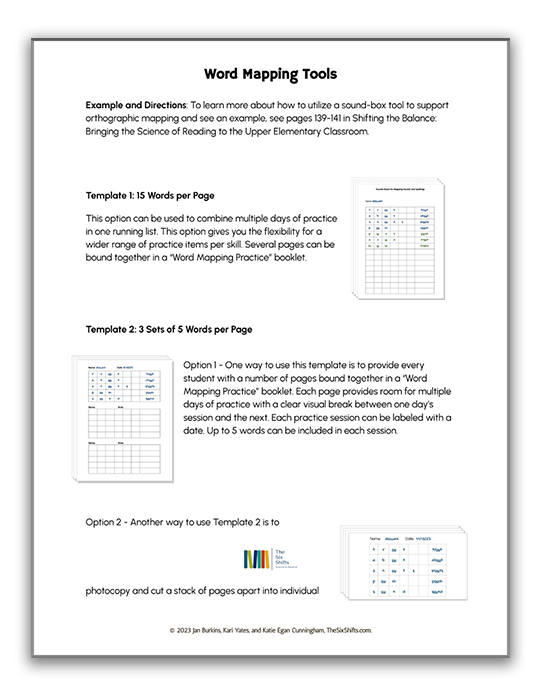
Free Printable Word Mapping Tools
Download your free PDF featuring a variety of sound box configurations ready to print and use for whole-group or targeted small-group intervention.
Download Printable PDF
3. Teach Students How to Tackle Longer Words
As students move through the upper grades, the words become longer, more academic, and more complex.
Even when students have solid single-syllable decoding skills, multisyllabic words can still create challenges. Reading longer words isn't simply a matter of stacking single syllables together. In many cases, pronunciation shifts, changes in syllable stress, and vowel sounds don't always behave the way students have come to expect.
In other words, two plus two isn't always four.
What many struggling readers need is a reliable process for approaching unfamiliar words when they encounter them in real reading.
Teaching students to:
- spot meaningful chunks,
- split longer words into manageable parts,
- try flexible vowel pronunciations and syllable stress,
- and connect known word parts to meaning
can dramatically increase their independence.
Even taking the time to study one or two multisyllabic words each day can help students develop routines that transfer into independent reading.
Writing big words can be just as powerful as reading them. When students learn to align sounds and spellings across an entire multisyllabic word, they develop stronger mental representations of the word that support both reading and writing.
If you'd like a practical classroom routine for teaching this process, download our Routine for Writing Big Words, adapted from Shift 4 in Shifting the Balance: 6 Ways to Bring the Science of Reading into the Upper Elementary Classroom. The routine provides a step-by-step process for helping students write longer words with greater accuracy, automaticity, and independence.

Routine for Writing Big Words Download
Get instant access to this instructional routine adapted from Shift 4 to build confidence, accuracy, and independence with multisyllabic decodable lists.
Go To Downloads PageRather than guessing, skipping the word, or waiting for someone else to tell them, students begin developing a problem-solving mindset they can apply across content areas.
That confidence matters because the longer the words become, the more students need strategies they can carry with them independently.

4. Use Morphology to Unlock Vocabulary, Spelling, and Decoding
Morphology is the study of meaningful word parts such as prefixes, suffixes, and bases.
For older students, morphology can be a powerful bridge between word recognition and language comprehension.
By the upper elementary grades, a large percentage of the unfamiliar academic vocabulary students encounter is built from Greek and Latin word parts. Understanding those meaningful parts gives students another pathway into words.
When students learn that words like predict, prediction, predictable, and predictor are connected, they begin to see how English words work together in meaningful families.
Morphology supports:
- vocabulary development
- spelling
- decoding
- reading comprehension
- content-area learning
For many struggling readers, high-leverage morphemes become powerful building blocks for solving longer words. Instead of trying to decode every sound in a six- or seven-syllable academic word, students can look for familiar prefixes, bases, and suffixes to break words into meaningful chunks and navigate complex words more efficiently.
Instead of approaching every unfamiliar word as a brand-new decoding challenge, students begin recognizing familiar building blocks that appear again and again.
Students begin noticing patterns and relationships among words. As those connections grow, vocabulary learning becomes faster and more durable across science, social studies, mathematics, and literature.
Morphology is a topic worthy of much deeper exploration. If you'd like to learn more about teaching morphology in the upper elementary grades, you'll find additional ideas and resources in this morphology post.

5. Strengthen Sentence-Level Comprehension
As students move into the upper grades, it's not just the words that become more complex. The sentences do too.
Sometimes students can read every word on a page and still struggle to understand what the text is saying.
When that happens, the problem often lives at the sentence level.
Many students need explicit support learning how sentences work and how ideas connect within them.
For example, students benefit from learning how to navigate:
- pronouns and referents ("He dropped it." Who is he? What is it?)
- relationship words such as however, although, because, and therefore
- increasingly complex sentence structures
- embedded clauses and multiple ideas packed into a single sentence
A sentence that begins with although immediately signals that two ideas are about to be compared, contrasted, or placed in tension with one another. Pronouns require readers to track information across multiple sentences. Embedded clauses ask readers to hold several ideas in mind at once.
One simple but powerful strategy is to occasionally lift important sentences out of a text and place them under the microscope. When students learn to unpack sentences and notice how ideas connect, comprehension often improves surprisingly quickly.
They become better able to follow the author's thinking and understand how meaning is constructed across a text.

6. Build Fluency Through Meaningful Repeated Reading
When selecting reading strategies for struggling readers, scaffolded repeated reading belongs near the top of the list.
Repeated reading gives students multiple opportunities to interact with grade-level language while building confidence, accuracy, and understanding.
There are many ways to make this happen:
- choral reading
- echo reading
- partner reading
- readers' theater
- technology-assisted reading
- guided repeated reading of short passages
The key is that students are rereading text for a meaningful purpose rather than simply trying to read faster.
In fact, repeated reading is one of the few fluency practices backed by decades of consistent research evidence (Therrien, 2004).
Of course, helping students become fluent is about much more than speed.
Fluency also involves accuracy, phrasing, pacing, and expression. When students read with appropriate intonation and phrasing, they are essentially helping their brains hear language that sounds like natural speech. That makes comprehension easier.
It's also important to remember that fluency is not the end goal. Improved fluency doesn't automatically translate into stronger comprehension. Students need opportunities to discuss, think about, and write about what they read (Wexler et al., 2010).
Fluent readers read accurately, smoothly, and with appropriate expression because they understand what they are reading.
Poetry, readers' theater, short passages, and partner reading all provide opportunities for students to strengthen both fluency and comprehension simultaneously.

7. Embed Writing Throughout the Day
Reading and writing support one another.
If there's one instructional move that deserves more attention, it's writing about reading.
Decades of research have shown that writing about text strengthens comprehension (Graham & Hebert, 2010), but the practical implication is simple: when students write about what they read, they think more deeply about it.
Writing requires students to select important information, organize their thinking, and connect ideas across a text. Those are exactly the kinds of mental processes that strengthen comprehension.
Perhaps even more encouraging, students don't need lengthy essays to benefit.
Research has shown that even brief writing tasks can improve comprehension and retention. The gains come from processing meaning, not from producing large amounts of writing.
Writing is especially powerful when paired with repeated reading. After rereading a text, students' written responses often become more accurate, coherent, and connected.
Students with reading difficulties, multilingual learners, and students with limited background knowledge often benefit disproportionately from writing-to-learn routines.
Writing slows thinking down and provides a built-in scaffold that helps students make sense of complex ideas.
A quick written response to a science text, a summary of a social studies lesson, or a brief explanation of mathematical thinking can all strengthen literacy skills.
These small moments add up over time.
They also provide some of the best windows into student thinking. Writing allows us to see what students understand, where misconceptions exist, how well they apply academic vocabulary, and whether foundational skills transfer to authentic tasks.
When writing becomes a regular part of the day, it serves both as instruction and assessment.
As Graham and Hebert concluded, writing about text doesn't simply measure comprehension. It strengthens it.

The Bottom Line
When we think about older readers with literacy gaps, it's tempting to look for a single strategy to solve the problem.
In reality, struggling readers need a combination of support.
They need help filling foundational gaps. They need tools for tackling longer words. They need vocabulary work, sentence-level comprehension practice, fluency practice, and opportunities to write.
Most importantly, they need all of those supports while continuing to engage with meaningful texts and content-rich learning.
Older struggling readers deserve instruction that addresses their gaps without reducing their opportunities to learn.
Their gaps may look younger. They aren't younger.
They need support. They need challenge. And they need both at the same time.
That's the idea behind Bricks & Mortar: Filling Literacy Gaps, our newest online class. In the class, you'll learn a flexible framework that combines targeted word work, sentence work, and passage work to help close literacy gaps while keeping students engaged in meaningful reading, writing, vocabulary, and content learning.

Bricks & Mortar: Filling Literacy Gaps 3-5+
Learn a flexible, actionable framework to bridge upper-elementary instructional shifts, close decoding challenges, and retain rigorous academic learning targets simultaneously.