A free set of Elkonin box templates, plus the routine that makes them work, one chip per sound, never per letter.
Free. Enter your email once and every resource on the site opens. We won’t ask again on this device.
Instant access. We never share your email. Unsubscribe any time.
Elkonin boxes, most teachers just call them sound boxes, are a row of empty squares, one per phoneme in a word. A child says the word slowly, pushes a chip into a box for each sound they hear, then swaps the chips for letters.
That last step is the whole point. Pushing chips is phonemic awareness. Replacing them with spellings is orthographic mapping: the process that turns a word a child has to sound out into a word they simply know. Sound boxes are one of the few classroom tools that make that bridge visible.
The most common error is drawing one box per letter. It feels intuitive and it quietly teaches the wrong thing, that spelling is a one-to-one match with sound, which English abandons almost immediately.
Getting this right in front of children is what separates a routine that builds mapping from one that builds confusion.

Say the word at normal speed first so the child hears it as a whole. Then stretch it. They repeat before touching anything: the mouth leads, the hands follow.
Push a chip into each box as the sound is said. If they push four chips for ship, don't correct the boxes, go back to the stretching. The error is in the hearing, not the writing.
Now write. A digraph fills one box. A split vowel spans two. This is the moment the child sees that English spelling has structure rather than caprice.
Blend it aloud, left to right. If it doesn't sound like the word, something is mapped wrong, and finding that together is worth more than getting it right first time.
Sound boxes earn their place in small-group work with words the child is close to knowing. They are not a warm-up, not a worksheet, and not something to send home unexplained.
Stop using them for a given word type once mapping is automatic. The goal is to make the scaffold unnecessary, a child still pushing chips for cat in March needs a different lesson, not more boxes.
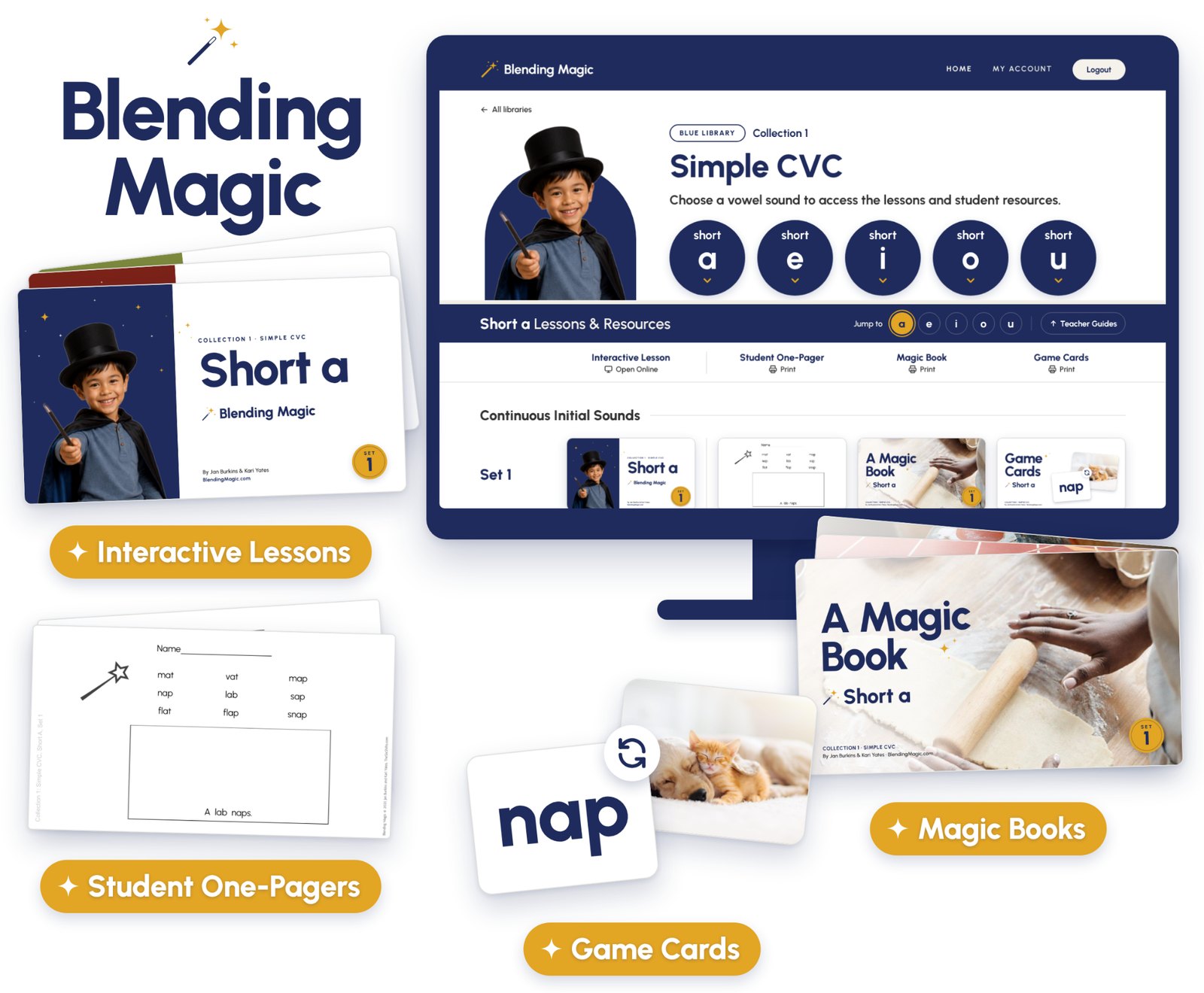
Sound boxes get the word mapped. Blending Magic is what makes the practice stick, animated blending lines your class works through together, with no prep.
One. A digraph is two letters making a single sound, so it fills a single box. Chip is three boxes: /ch/ /i/ /p/.
The silent letter shares a box with the vowel it's working on. In make, the a and the final e occupy the same box together, because between them they make one sound.
Most useful in kindergarten through second grade. Interventionists use it well beyond that with students who still need the sound-to-spelling bridge, the routine doesn't age out, the word choice just changes.
Anything works: counters, pennies, cereal. What matters is that the object moves. The physical push is what anchors the sound in a way pointing doesn't.
Four pages, ready to print. Enter your email once and every free resource on the site unlocks, this one included.
Once children can map single-syllable words reliably, the next constraint is usually high-frequency words, the ones that appear constantly and don't always play fair. That's what the 109 Power Words list is for.
Keep going
The high-frequency words worth teaching first.
Templates for connecting sounds to spellings.
Why ship has three phonemes and box has four.
A one-page scope and sequence for your table.