
Chances are, you’ve had a dialogic conversation this week—and didn’t even realize it.
Maybe you asked an open-ended question. “How was your trip to the dentist?”
- Waited for a student to answer. “I have a bad tooth in the way back and have to get a cavity next week.”
- Affirmed what they said by repeating, expanding, and or clarifying. “Oh. You’ve got a tooth with a cavity and have to get a filling next week. The filling is what you get when they fix the cavity.”
- And kept the conversation going. “What did the dentist have to say?”
- Waiting again. “That I need to brush more better in the back.”
- And repeating the process. “Ahh, yes! Brush better in the back. Scrub those big back molars.”
You likely didn’t plan it.
And you maybe didn’t realize all the hidden benefits of conversations like these.
Dialogic conversations aren’t another thing to add to your already-full plate. They’re something you’re likely already doing (mostly). And with just a shift in intention, these everyday exchanges can become powerful moments for language growth, vocabulary development, and deeper thinking.
We’ll show you how to recognize, enrich, and intentionally lean into these moments—so you can make the most of the language-building opportunities hiding in plain sight.
Enter Dialogic Reading
If you’ve heard of Dialogic Reading, you may already know it’s a research-based method that transforms a simple read-aloud into a rich, interactive learning experience. We introduced the idea of Dialogic Reading—and its more flexible sibling, dialogic conversations—in our first Shifting the Balance book, along with a helpful visual to support your experimentation (Download a PDF here).

In this post, we want to help you take your understanding and use of dialogic conversations even further—whether the term is brand new to you or you’re already a seasoned facilitator of these lovely and powerful exchanges.
But First, What Are Dialogic Conversations?
Although dialogic conversations can be used in many settings while conversing with adults, at their core, these conversations are rich, back-and-forth interactions between an adult and a child. They unfold more like a dance than a drill, prioritizing responsiveness over rigid structure. Rather than delivering information or firing off rapid questions, the adult invites the child to think, respond, explore, and extend ideas. These exchanges are open-ended, emotionally safe, and intellectually stimulating.
While this approach originated in the context of storybook reading with very young children at home (Whitehurst et al., 1988), it generalizes beautifully to all ages and settings. Whether during playtime, mealtime, a walk, or a ride in the car—dialogic conversations thrive in everyday moments.
Because they involve repeating and building on what the speaker says, they require active listening and thoughtful confirmation. These small but powerful habits show the speaker you care about their ideas and are genuinely tuned in.
That’s why we lean toward the more inclusive term Dialogic Conversation over Dialogic Reading. This process isn’t just for storytime—it’s a way of being in conversation with others. And when it becomes second nature, it supports communication with everyone—from your students to your parent volunteers to your spouse. It helps all participants feel heard, understood, and invited to grow.
What the Research Says About Dialogic Conversations
One of the most consistent findings in the science of reading is the link between oral language development and reading comprehension, as noted in our second Shifting the Balance book (Cunningham, Burkins, & Yates, 2023):
“Recent research shows that vocabulary can account for as much as 80 percent of students’ scores on reading comprehension assessments” (Reutzel & Cooter, 2015, pp. 77–78).
This makes intuitive sense. If students don’t understand the words, they can’t access the meaning. Reading comprehension rests on language comprehension—which means the language students are acquiring today will be the very language they use to comprehend texts tomorrow (Burkins & Yates, 2021).
So, how do we intentionally support vocabulary and language development?
Research shows that children who engage in frequent, rich conversations with adults develop stronger vocabulary, listening comprehension, and expressive language (Snow, 2010). And while peer interactions—on the playground or in structured turn-and-talks—are valuable, they don’t offer the same level of linguistic stretch. When children speak with someone who has more advanced language skills and who knows just how far to push their thinking, they encounter new vocabulary and language structures in meaningful, emotionally validating ways.
Although Dialogic Reading originated with read-aloud, it isn’t the format that makes it effective—it’s the interaction. In fact, children who participate in read-aloud with Dialogic Conversation show up to eight times more vocabulary growth than those who simply listen to a book read aloud (Mol et al., 2008)! Wow! And that accelerated vocabulary growth is a powerful lever for reading comprehension—especially if vocabulary accounts for up to 80% of what students understand when they read.
These effects extend beyond early childhood. Additional research has shown that dialogic strategies benefit older students as well, especially during shared reading, project-based learning, and other knowledge-building conversations (Wasik & Hindman, 2020). They also serve emergent bilinguals and students from a wide range of socioeconomic backgrounds. Among instructional routines, dialogic conversations are supported by an unusually robust body of evidence—and an encouraging amount of practical promise.
What Are the Parts of a Dialogic Conversation?
To make dialogic conversations feel more doable in practice, it helps to break them down into a simple, five-step process: Prompt, Repeat, Expand, Correct, Again. These steps create a conversational rhythm that nurtures language development while keeping interactions dynamic and responsive.
We’ve made this classroom poster for you to post opposite where you often engage in conversations with students. It can serve as a reminder of each of the steps as the process gets increasingly automatic because of your commitment to practicing it.

Below, you’ll find a breakdown of each step, including examples across age levels to show how this practice works in real classrooms. We’ve included very young children intentionally because language comprehension has to develop before reading comprehension can flourish. And understanding how to support families in having these conversations even before children enter school can be a game-changer.
Step 1: Prompt
The first step in a Dialogic Conversation is to offer an open-ended prompt—a question, picture, event, or comment that requires more than a one– or two–word answer and encourages a child to think, talk, and make meaning. A well-placed prompt shifts a child from passively listening to actively engaging, sparking curiosity and connection.
Whether you’re asking about a picture book illustration, a historical figure’s motivation, or a science phenomenon, the goal is the same: to invite children into deeper thinking and meaningful talk.
🫘 Prompting a One-Year-Old:
While reading Brown Bear, Brown Bear, What Do You See? by Bill Martin Jr. and Eric Carle, a parent pauses on the page with the yellow duck and asks, “Can you point to the duck?” While not open-ended, this simple prompt still invites participation and language-building for our youngest learners.
🫘 Prompting in a Group of First Graders:
During a read-aloud of A Sick Day for Amos McGee by Philip C. Stead and Erin E. Stead, the teacher pauses at the page where Amos visits the elephant and asks, “Why do you think the elephant looks so sad?” This open-ended prompt nudges children to study the picture, connect it with the story, and formulate a plausible response.
🫘 Prompting in a Group of Third Graders:
While reading Because of Winn-Dixie by Kate DiCamillo, a second-grade teacher pauses during the scene where Opal begins asking about her mother and asks, “Why do you think Opal is making a list of things she wants to know?” This prompt encourages students to infer Opal’s emotions and reflect on how people process absence or longing.
🫘 Prompting in a Group of Fifth Graders:
During Inside Out and Back Again by Thanhhà Lại, the teacher pauses as Hà describes being laughed at for mispronouncing English words and asks, “How do you think Hà feels when her classmates laugh at how she speaks?” This question opens space for empathy and deeper discussion about language, identity, and belonging.
 Developing a Green Thumb for Prompting:
Yes, open-ended questions are powerful—but they don’t have to be complex or profound. The true art of prompting lies in your knowledge of the listener. The best prompts stretch students just a little past what they already know—what Vygotsky called the Zone of Proximal Development (ZPD)—while still feeling safe and accessible.
Think of a great prompt like planting a seed: it might seem small, but with the right timing and care, it can grow into rich, sustained conversation.
Step 2: Repeat
Obviously, step 1.5 in this process is giving students time to think (and maybe even talk with one another) before listening to an individual student respond to the prompt. As adults, it can be easy to minimize the importance of wait time—but if we want thoughtfully formulated responses, kids need time to think..
Once the child responds to the prompt, the teacher moves to Repeat—restating what a child has said. This repetition shows the child that their thinking is important and worthy of attention, while also letting all the children hear the language once again, with the adult’s clear articulation and inflection.
Of course, in a group setting, this step is only practical with one student at a time, but all students can receive the benefits as they listen to you engage in the rest of the process. Over time, in fact, you are likely to find that students internalize this process and begin to use it with each other, which is a lovely and powerful byproduct of our commitment to automating these steps!
Example: If the child answers, “Because Amos isn’t there,” the adult might respond, “Oh, you think the elephant looks sad because Amos isn’t there.” This repetition not only confirms the child’s idea but keeps the conversation going.
🌱 Repeating for a One-Year-Old:
When the child points to the yellow duck, the adult “repeats” by saying, “Yes, a yellow duck!” This repetition—even when a child hasn’t technically spoken—reinforces the child’s language, models clear pronunciation, and helps build early word knowledge through affirmation and connection.
🌱 Repeating in a Group of First Graders:
A child responds to the prompt about why the elephants are sad by saying, “Because Amos isn’t there.” The adult repeats what the child says: “Oh, you think the elephant looks sad because Amos isn’t there,” or “Yes, Amos isn’t there, and that is sad.”
🌱 Repeating in a Group of Third Graders:
After participating in turn-and-talk with a partner, a student responds to the earlier prompt about Opal asking so many questions by saying, “She wants to know her mom better.” The teacher repeats the idea back: “She may want to know her mom better.”
🌱 Repeating for an Individual From a Group of Fifth Graders:
After discussing the prompt with a classmate, a student answers the question about how Hà feels by saying, “She probably feels embarrassed and doesn’t want to keep talking.” The teacher echoes the student’s response with, “So, you and your partner think she feels embarrassed.”
Developing a Green Thumb for Repeating Well:
Step 2, of the process—Repeat—is not difficult in theory. What makes a repetition really smooth is when it just feels like part of the conversation, rather than a verbatim paroting of what a student said. Those who are skilled in this kind of repeating—which serves both as affirmation and as language extension—are able to navigate the dance between the science of deepening neural pathways, through repetition and practice, as well as the sciences of connection and voice.
Step 3: Expand
After a child’s idea has been repeated and affirmed, the next move is to expand—adding just a little more to stretch their thinking, expand the sentence structure, or introduce more vocabulary. This might be a richer word, a slightly deeper idea, or a more specific phrase. The expansion builds directly on what the child has said, keeping the conversation rooted in their thinking while nudging it forward.
The goal isn’t to correct or replace the child’s language but to offer something just beyond what they’ve already said—something they’re ready to take on with your support. In this way, expansion becomes one of the most powerful opportunities to grow vocabulary and deepen comprehension.
🌿 Expanding for a One-Year-Old:
After the child points to the yellow duck and the adult repeats, “Yes, it’s a yellow duck,” the adult adds, “The duck says quack-quack!” This small expansion introduces sound play and connects the word to action in the world.
🌿 Expanding in a Group of First Graders:
After a child says, “Because Amos isn’t there,” and the teacher repeats, “ Amos isn’t there and that is sad,” the teacher adds, “Maybe the elephant feels lonely because he misses his friend.” The expansion helps children move from cause-and-effect to emotional understanding.
🌿 Expanding in a Group of Third Graders:
After the student says, “She wants to know her mom better,” and the teacher repeats, “Yes, she may want to know her mom better,” the teacher adds, “And maybe she feels confused or even a little hurt because there’s so much she doesn’t understand yet.” This introduces new emotional language and encourages deeper inference.
🌿 Expanding for an Individual From a Group of Fifth Graders:
After a student shares, “She probably feels embarrassed and alone,” and the teacher repeats, “So you and your partner think she feels embarrassed and doesn’t want to do a lot of talking,” the teacher expands, “Yes, she might try to avoid conversation.” The expansion adds precision and more complex vocabulary.
Developing a Green Thumb for Expanding:
Step 3, Expanding is where vocabulary and comprehension start to flourish—but it doesn’t require big leaps or complex language. In fact, research shows that for children to learn a new word, they need to understand 95% of the surrounding words in the sentence (Schmitt et al., 2011). This means your expansion doesn’t have to be elaborate—just intentional.
A well-placed expansion might include one new word, one slightly more specific phrase, or one added idea that’s still grounded in what the child said. When done skillfully, it feels like a natural continuation of the conversation—not a correction or a detour.
The best expansions are relevant:
- They are connected to the child’s original thought.
- They are calibrated to what the child is ready for next.
Expansions quietly say, “I hear you—and here’s a little more language we can use to think about that together.”
Step 4: Clarify
Once a child’s idea has been repeated and built on, the next opportunity may come in the form of a clarification or gentle correction. This step is often misunderstood, but it’s not about pointing out mistakes in a harsh or formal way. In fact, errors are a beautiful sign that a child is stretching, experimenting, and testing the edges of what they know. Mispronunciations, approximations, and overgeneralizations are all part of natural language development, and they often reflect partial understandings—exactly the kind of thinking that’s ready to grow.
A teacher’s role in these moments is to stabilize the learning, often by restating something more accurately, more clearly, or more precisely. Many times correction isn’t necessary at all. Or, the clarification can be a part of either the Repeat or Expand steps, and other times it stands on its own.
Either way, it should feel like a natural part of the conversation—embedded with care. It can be as simple as echoing the idea back with the correct word or offering a new phrasing that clarifies the meaning without calling attention to the error. When done well, it builds confidence and clarity.
🪴 Correcting for a One-Year-Old:
After the child points to the yellow duck and makes a sound like “dah,” the adult says, “Yes! That’s a duck—a yellow duck!” By repeating the correct word naturally and enthusiastically, the adult affirms the effort while modeling more accurate language, nudging the child gently forward without pressure.
🪴 Correcting in a Group of First Graders:
A child says, “The elephant is crying because he don’t got no one.” The adult repeats warmly, “Oh, you think he’s sad because he doesn’t have anyone to be with.” This subtle correction, tucked into the repeat, helps the group hear a clearer version of the sentence while affirming the idea underneath it.
🪴 Correcting in a Group of Third Graders:
After the student says, “She wants to memorize her mom’s life,” the teacher replies, “Yes, maybe she wants to remember her mom or learn more about her story.” Without pausing to correct explicitly, the teacher subtly replaces “memorize” with more fitting vocabulary—strengthening the student’s understanding of both meaning and word choice.
🪴 Correcting in a Group of Fifth Graders:
When a student says, “Hà felt shaming when they laughed at her,” the teacher affirms the insight and gently revises: “Yes, she might have felt ashamed or embarrassed in that moment—it can be really painful to feel so different.” The conversation keeps moving, but the teacher has modeled a more accurate word form and added depth to the emotional vocabulary.
Developing a Green Thumb for Clarifying:
Step 4, Clarify, is not about fixing mistakes—it’s about catching a teachable moment and offering something sturdier to stand on.
Children’s approximations and errors are invitations—they show you exactly where learning is trying to happen. When we respond with warmth, clarity, and careful modeling, we reinforce the neural pathways that support the language that will become the superhighways for their reading comprehension.
This step is most effective when it’s woven gently into the flow of the conversation—often inside the Repeat or Expand moves. “She don’t got no one” becomes “She doesn’t have anyone.” “Memorize her mom’s life” becomes “remember or learn about her mom.” These shifts may seem small, but over time, they refine a child’s command of language in meaningful ways. Depending on the relationship you have with the child and the context of the encounter—whole group vs. alongside an individual child—you may ask a child to listen to you articulate a mispronounced word and then resay it. These are judgment calls that only you can make based on your knowledge of your students.
The best clarifications or corrections are quietly powerful—they preserve the child’s confidence, honor the substance of their words, and guide their growth.

Step 5: Return
Step 5 is to return to the beginning of the process to sustain the conversation in authentic ways. Dialogic conversations are not formulaic one-and-dones.
They are meant to be part of a conversational rhythm, not a moment.
After prompting, repeating, expanding, and clarifying one idea or response, we return to the process with a new page, a new idea, or a new student. In this way, “Sustain” is about re-engaging the cycle. It’s what builds depth over time, allowing children to grow their thinking page by page and turn by turn.
Each time we return to the cycle, we’re building new layers—adding vocabulary, developing comprehension, and nurturing confidence. This repeated, intentional engagement creates opportunities for all students to be drawn into the learning process.

Beyond Books: The Dialogic Conversation Process Anytime, Anywhere
Dialogic conversation isn’t limited to text experiences—it’s a mindset for nurturing language and thinking throughout the day. The same principles—prompting, listening, repeating, expanding, and clarifying—can be woven into transitions, routines, and even casual chats.
In fact, these informal moments are often when children feel most at ease, making them especially rich opportunities for planting connections and growing oral language. Whether you’re walking to music or handing out folders, turning everyday moments into mini-conversations helps reinforce vocabulary, social-emotional skills, and trust.
The table below offers a few ideas to get you started—but once you begin looking, you’ll see opportunities everywhere.
Dialogic Moments All Day Long (+ Prompts)
🕘 WHEN
PROMPT (CONVERSATION SEEDS 🫘)
On the way back from lunch
“How do you eat your meals, one thing at a time or a little of everything all during lunch?”
During morning arrival
“What are you looking forward to today?”
While passing out supplies
“Why do you think we need glue for this activity?”
In line for recess
“What plans do you have for recess?”
After a conflict or disagreement
“What do you think would help fix the problem?”
During clean-up time
“What’s something you helped with today?”
Lining up for dismissal
“What’s something you learned today that you could share at home?”
Mastering the Dialogic Conversations Process
Even though the concept is simple, dialogic conversations require practice to implement consistently. That’s because after hours, days, years—even decades—of working with children, our conversational habits are deeply ingrained. These well-worn patterns aren’t necessarily bad, but they’re automatic. And if we want to accelerate students’ language development (think: reading comprehension), we have to be intentional about building new habits.
The process itself is simple. But unlearning and replacing established routines takes time, focus, and repetition—just like we ask of our students.
In our work with each other, with teachers, and with students, we’ve noticed a few common pitfalls. Almost all of them involve condensing or skipping parts of the process. The table below shows just how easy it is to leave something out.
See if you can spot the missing or weakened step before reading the explanation. In each example, the teacher’s response is in bold, and the analysis includes icons representing each step in the process—just like those at the beginning of this post and at the bottom of the table.
Common Mistakes in Facilitating Dialogic Conversations
| Teacher | Student | Analysis |
|---|---|---|
| Example 1 | ||
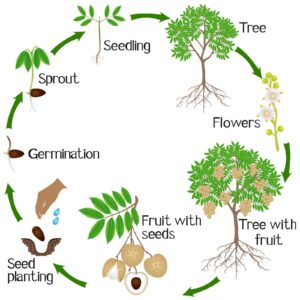
| Look at this part of the diagram where the seed is just beginning to sprout. What do you think is happening under the soil? | The seed is waking up and starting to grow leaves. | The teacher skips the Repeat step. BETTER: “You think the seed is waking up and beginning to sprout leaves. 🌱🌿 What does it need during this stage?” 🔄 |
| Yes—and actually, before the leaves even show, the seed sends out little roots to find water in the soil. |
||
| Example 2 | ||
| Now, let’s look at the next stage in the diagram. What do you notice about the plant after it grows leaves? | The leaves start to spread out. | The teacher skips the Repeat and Expand steps before prompting again. ALTERNATIVE: “So you’re noticing the leaves are spreading out. 🌱 They are stretching in both directions. 🌿 What might that help the plant do?” 🔄 |
| And then what do they do? | ||
| Example 3 | ||
| Look closely at this diagram. Why do you think it’s in a circle? | Because it goes back to where it started. The seed becomes a tree and the tree gives us new seeds. | This teacher is trying to accomplish too much at once and getting too far away from the familiar language on which the expansion needs to build. ALTERNATIVE: “Exactly—it goes back to where it started. 🌱 The diagram shows us a cycle, or a process that repeats—a seed becomes a tree, the tree bears fruit, and the fruit gives us the next generation of seeds. 🌿 What could interrupt that process?” 🫘 |
| Yes, because it embodies a perpetual cycle—what begins as a single seed eventually matures into a towering tree, ultimately giving rise to new seeds via the development of flowers that become fruit that generates the next generation of seeds. | ||
| Conversation | Analysis |
|---|---|
| T: Look at this part of the diagram where the seed is just beginning to sprout. What do you think is happening under the soil? S: The seed is waking up and starting to grow leaves. T: Yes—and actually, before the leaves even show, the seed sends out little roots to find water in the soil. | The teacher skips the Repeat step. REFINEMENT: “You think the seed is waking up and beginning to sprout leaves.”.🌱🌿 |
| Example 2 | |
| T: Now, let’s look at the next stage in the diagram. What do you notice about the plant after it grows leaves? S: The leaves start to spread out. Yes—and actually, before the leaves even show, the seed sends out little roots to find water in the soil. | What does it need during this stage? 🔄 ALTERNATIVE: “So you’re noticing the leaves are spreading out. 🌱 They are stretching in both directions. 🌿 What might that help the plant do?” 🔄 |
| Example 3 | |
| T: Look closely at this diagram. Why do you think it’s in a circle? S: Because it goes back to where it started. The seed becomes a tree, and the tree gives us new seeds. T: Yes, because it embodies a perpetual cycle—what begins as a single seed eventually matures into a towering tree, ultimately giving rise to new seeds via the development of flowers that become fruit that generates the next generation of seeds. | This teacher is trying to accomplish too much at once and getting too far away from the familiar language on which the expansion needs to build. BETTER: “Exactly—it goes back to where it started. 🌱 The diagram shows us a cycle, or a process that repeats—a seed becomes a tree, the tree bears fruit, and the fruit gives us the next generation of seeds. 🌿 What could interrupt that process?” 🫘 |
Closing Thoughts
While the goal is to become increasingly skilled and automatic with this process, the reality is that not every conversation can be fully dialogic. Even with the time and the intention, the competing demands of a classroom mean that sometimes—maybe even often—you’ll expand but forget to repeat, or you’ll ask a yes/no question instead of something open-ended.
But classroom life keeps moving. If you can do just a little more—repeat more often, expand more intentionally, or set aside one conversation a day to practice—the benefits will grow.
And while you won’t master this process overnight, trust that each time you prompt, repeat, expand, correct—and then do it all again—language is quietly rooting, leafing, and reaching upward.
Because in the end, it’s not just about using an instructional strategy.
It’s about growing a language-rich classroom culture—one expanding conversation at a time.
References
Burkins, J., & Yates, K. (2021). Shifting the Balance: 6 Ways to Bring the Science of Reading into the Balanced Literacy Classroom (K–2). Stenhouse Publishers.
Cunningham, K. E., Burkins, J., & Yates, K. (2023). Shifting the Balance: 6 Ways to Bring the Science of Reading into the Upper Elementary Classroom (3–5). Stenhouse Publishers.
DiCamillo, K. (2000). Because of Winn-Dixie. Candlewick Press.
Keats, E. J. (1962). The Snowy Day. Viking Press.
Lại, T. (2011). Inside Out and Back Again. HarperCollins.
Martin Jr., B., & Carle, E. (1992). Brown Bear, Brown Bear, What Do You See? Henry Holt and Company.
Mol, S. E., Bus, A. G., de Jong, M. T., & Smeets, D. J. H. (2008). Added value of dialogic parent–child book readings: A meta-analysis. Early Education and Development, 19(1), 7–26.
Nagy, W. E., Herman, P. A., & Anderson, R. C. (1985). Learning words from context. Reading Research Quarterly, 20(2), 233–253. https://doi.org/10.2307/747758
Reutzel, D. R., & Cooter, R. B. Jr. (2015). The essentials of teaching children to read: The teacher makes the difference (3rd ed.). Pearson.
Schmitt, N., Jiang, X., & Grabe, W. (2011). The percentage of words known in a text and reading comprehension. The Modern Language Journal, 95(1), 26–43. https://doi.org/10.1111/j.1540-4781.2011.01146.x
Snow, C. E. (2010). Academic language and the challenge of reading for learning about science. Science, 328(5977), 450–452. https://doi.org/10.1126/science.1182597
Stead, P. C., & Stead, E. E. (2010). A Sick Day for Amos McGee. Roaring Brook Press.
Vygotsky, L. S. (1978). Mind in Society: The Development of Higher Psychological Processes. Harvard University Press.
Wasik, B. A., & Hindman, A. H. (2020). Dialogic reading and preschoolers’ development of academic language: A randomized controlled trial. Early Childhood Research Quarterly, 50, 45–56. https://doi.org/10.1016/j.ecresq.2019.01.002
Whitehurst, G. J., Arnold, D. S., Epstein, J. N., Angell, A. L., Smith, M., & Fischel, J. E. (1988). Accelerating language development through picture book reading. Developmental Psychology, 24(4), 552–559.

-
Jan Burkins and Kari Yates are authors, speakers, and consultants, who are dedicated to helping teachers around the world translate reading science into simple instructional moves that help teachers make learning to read easier for their students while still centering meaning-making, engagement, and joy.